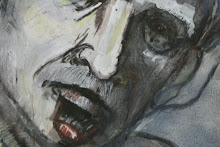
Split Screen - detail

Split Screen - detail
An image of our fractured natures

Monday, January 11, 2010

Split Screen


Part of a body of work shown in Damascus in August 2008 at the Art House Gallery. The exhibition was entitled Ana Meen; Enta Meen (Arabic for Who Am I; Who Are You).

Thursday, May 22, 2008

Al Burj Al Mabni - Detail View 2

Al Burj Al Mabni - Detail View

Al Burj Al Mabni - Back View

Al Burj Al Mabni


Al Burj Al Mabni means The Constructed Tower. This work refers to the marketed version of Dubai, my current home, against the reality on the ground. Thousands of nameless, faceless laborers have built this city, but they gain no credit for doing so. They cannot move here, they struggle with difficult conditions, sometimes not even being paid their salaries regularly. To be fair, the government does address the problems as they arise, but I still feel they should be afforded some dignity and thanks for their efforts.

Accessories for the Occupation - Earrings


The following series of four works all fall under the Accessories for the Occupation. Stones thrown in protest, stones from rubble of homes that have been illegally demolished. Razor Wire that delimits and delineates where one can move regardless of if it's their land or not. I chose the guise of fashion because I feel more people pay attention to that than to human suffering and injustice in our world. If we make tragedy fashionable, and suffering a red-carpet event, perhaps something may happen

Accessories for the Occupation - Ring

Accessories for the Occupation - Necklace

Accessories for the Occupation - Belt

Sunday, October 7, 2007

Images from Beirut

After Cairo, I moved to Beirut, and this environment had a significant impact on my use of color and subject matter. Lebanon is a stunning country with beaches, mountains, cities, villages, and ancient sites. All of this is packed into a tiny country (compared to Canada, my home), and the variety does not stop with the geography. The people in Lebanon are highly diverse and regional as well. My greatest challenge was to find some commonality, what ran through all of this tying the people and place together, if anything. I began a series of color studies, taking for influences the intensely various qualities of sunlight and how it changed the colors of the natural and urban environments. As opposed to Cairo, my palette expanded into a much wider range. After a time, I began to notice something with the people. There seemed to be a tremendous sense of waiting, as if the answers were just around the corner. Political malaise, international interference, economic instability, and sectarian differences would all be worked out, perhaps tomorrow but soon. I felt a sense of unrealized potential that had little outlet within society, and along with this sense of waiting, I noticed the great love of diversion in many forms. Outdoor activities, comparing styles, looking each other over, up, and down, mobile phones, comparing ailments and medications, and an active nightlife were all participated in to divert attention from the boredom of waiting. This was the complexity I was after with my work. I still don't feel as if I have got it just yet and much of the works are still being sifted through and altered.

Red Flower (in progress)

Adam II and Eve II - Beirut

Two Beirut Portraits

Lady at the Window - Sodeco

Green Man - Beirut

Waiting for Monot

Thursday, October 4, 2007

Images from Cairo

My time in Cairo was highly significant in my development as an artist. I had left Canada and my formalist roots behind with the purpose of developing a body of work that would reflect a new a very different culture. In Cairo, I began a series of drawings, but I was unsatisfied after six months. The main reason was the work was only on the surface, and Cairo had begun to open up to me. Three things kept coming up in my mind. One, Cairo was the recycling capital of the world. Each neighborhood has a Ruba Bikya man, who rolls his cart though the area calling out "Ruba Bikya" or just "Bikya", which comes from Italian for "Old Clothes". He collects everything and anything that can be traded, fixed or re-used, which pointed to the process I used with these works. Second, even though Cairo is polluted and dirty, there are moments when the city glows with beautiful color and has a serene calmness. These times were rare, but greatly appreciated due to that rarity. From this I tried to capture the moment without losing the rawness. Third, the faces in the turbulence of the city kept sticking in my memory. There is a raw energy in the city that for a second will slow down to show you a scene or a cameo that has a poignancy showing humanity at its best, worst, and most real, then the moment is gone in the swirl. All of this was going through my mind as I recycled my works, collaging, drawing, and painting over top of the first body of work until I felt I had captured something of the essence of this complex and compelling city.